
I get this question more than you'd expect. A Canadian player signs up for eZeeWallet to fund their casino account, the deposit goes through in seconds, and suddenly they wonder: can I use this thing for everything else too? Groceries, online shopping, splitting a dinner bill with friends?
I spent three weeks trying to use eZeeWallet as my everyday digital wallet across Canada. The short answer is disappointing. The longer answer involves some important nuances that every Canadian user should understand before parking serious money in this platform.
What eZeeWallet Claims to Offer
On paper, eZeeWallet positions itself as a full-service digital wallet. The official marketing language on their website and app store listings promises that users can "deposit, spend and transfer money all in one place." The app description on both Google Play and the Apple App Store highlights instant payments, secure wallet-to-wallet transfers, and the ability to send money across the globe.
That sounds like a competitor to PayPal, Wise, or even Interac e-Transfer. The parent company, emerchantpay Ltd, has over two decades of payment processing experience and operates in 189 countries. They hold FCA authorization in the UK, ISO/IEC 27001:2013 certification, and PCI DSS compliance. Those credentials are legitimate and strong.
But credentials and real-world Canadian utility are two very different things.
The Merchant Acceptance Problem
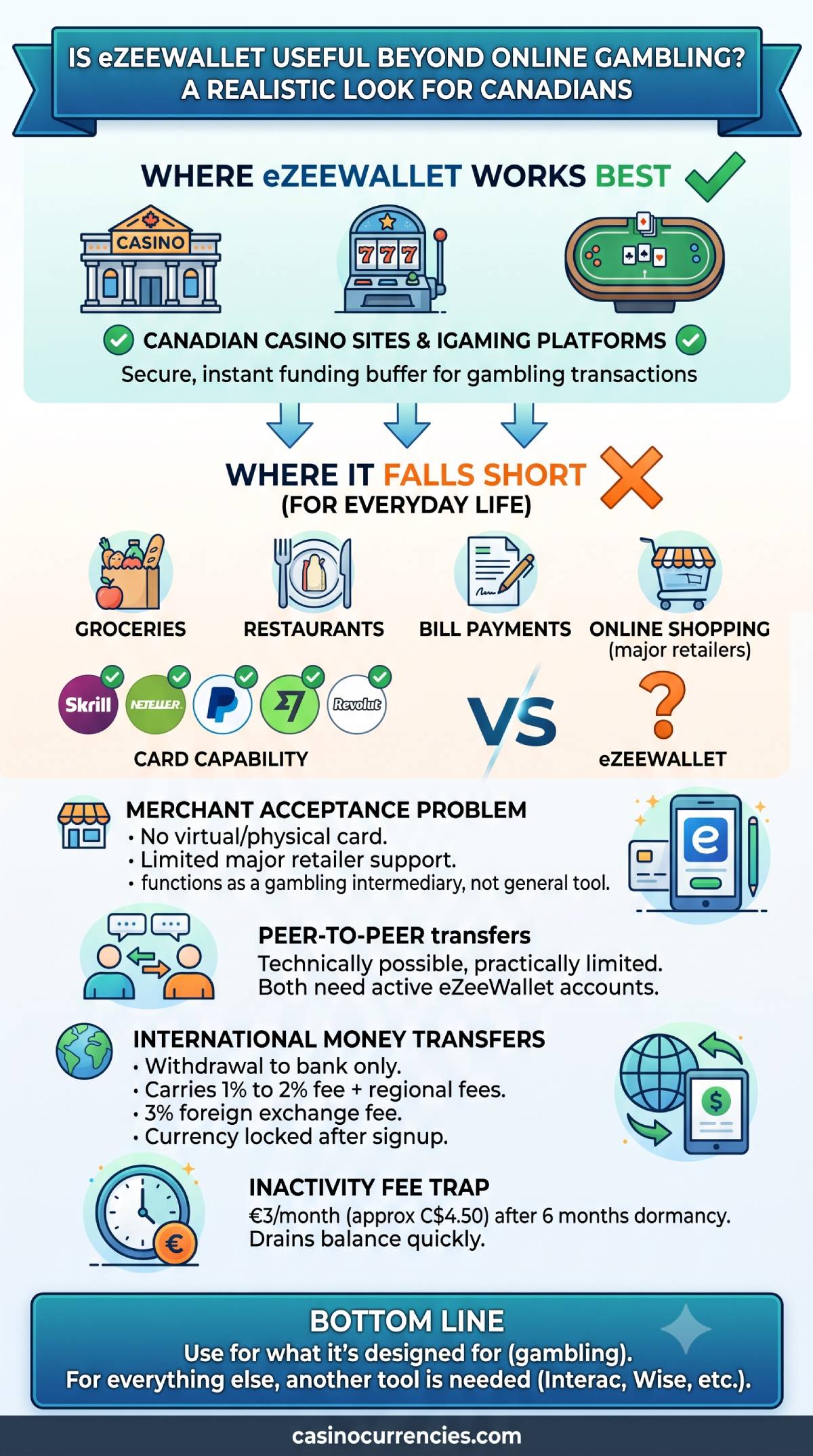
Here's the fundamental issue. eZeeWallet does not issue a physical or virtual debit card. Unlike MuchBetter (which offers a prepaid Mastercard through Peoples Group in Canada), Skrill, Neteller, or even newer fintech wallets like Wise and Revolut, eZeeWallet gives you no card-linked spending capability whatsoever.
That single missing feature eliminates roughly 95% of everyday use cases. Without a Visa or Mastercard-branded card tied to your balance, you cannot tap to pay at a coffee shop in Toronto. You cannot use it at a grocery store in Vancouver. You cannot add it to Apple Pay or Google Pay for contactless purchases. You cannot pay your Rogers or Bell phone bill with it.
The merchants that do accept eZeeWallet directly are almost exclusively online casinos and gambling platforms. During my testing, I could not find a single major Canadian retailer — online or brick-and-mortar — that lists eZeeWallet as a checkout option. No Amazon.ca, no Shopify stores, no Canadian Tire, no Loblaws online delivery.
This puts eZeeWallet in a fundamentally different category than true general-purpose e-wallets. It functions as a gambling payment intermediary, not a lifestyle financial tool.
Peer-to-Peer Transfers: Technically Possible, Practically Limited
eZeeWallet does support wallet-to-wallet transfers between registered users. You can send money to another eZeeWallet account holder with no fees — a genuinely useful feature in theory.
In practice, the limitation is obvious. Both the sender and receiver need active eZeeWallet accounts. Given that the wallet's user base skews overwhelmingly toward online gamblers, finding someone in your personal circle who also has an eZeeWallet account is unlikely unless they're also active casino players.
Compare this to Interac e-Transfer, which works with virtually every Canadian bank account. Or PayPal, which has over 430 million active accounts globally. The network effect that makes peer-to-peer payments convenient simply doesn't exist for eZeeWallet in Canada outside the iGaming community.
What About International Money Transfers?
eZeeWallet supports 14 currencies including CAD, EUR, GBP, and several Latin American and Scandinavian currencies. The platform operates in 189 countries, which sounds impressive for cross-border payments.
However, the withdrawal process is limited to bank transfers only. You load money in, and the only way out (besides spending at a supported merchant, which means a casino) is to send it back to a bank account. That bank withdrawal carries a percentage-based fee — typically 1% to 2% — plus potential flat fees depending on your region.
For Canadians sending money internationally, services like Wise charge transparent fees at the mid-market exchange rate. Interac e-Transfer handles domestic transfers instantly for free through most Canadian banks. eZeeWallet's 3% foreign currency exchange fee makes it an expensive option for international transfers compared to purpose-built alternatives.
There's also a significant drawback that most users overlook. You cannot change your account's default currency after registration. If you set up in CAD and later need to send EUR regularly, you'd have to close your account entirely and create a new one. That's a dealbreaker for anyone managing multi-currency needs.
The Inactivity Fee Trap
This detail matters for anyone considering eZeeWallet as a secondary wallet for occasional non-gambling use. After six months of inactivity, the platform charges €3 per month (approximately C$4.50) until your balance reaches zero or you reactivate the account.
If you deposit C$50 thinking you'll use it for miscellaneous purchases and then forget about it, the inactivity fee will drain your balance within roughly 11 months. That's money gone with zero value received.
MuchBetter charges a similar dormancy fee (C$5/month), but the crucial difference is that MuchBetter gives you a prepaid Mastercard. You can at least spend down your balance at any Mastercard-accepting merchant before dormancy kicks in. With eZeeWallet, your options for spending the balance are limited to casino deposits or eating the bank transfer withdrawal fee.
Where eZeeWallet Actually Excels
I don't want to paint an entirely negative picture. Within its intended ecosystem, eZeeWallet performs well. For Canadian online casino players specifically, it offers several legitimate advantages over sharing bank details directly with gambling operators.
- Privacy buffer: Your banking information stays with eZeeWallet, not scattered across multiple casino platforms. In an industry where data breaches occasionally make headlines, that separation has real value.
- Deposit speed: Casino deposits through eZeeWallet are genuinely instant. There's no three-day hold, no pending period, no declined transactions from banks that flag gambling charges.
- Budget compartmentalization: Loading a set amount into eZeeWallet creates a natural spending boundary for your gambling activity. When the wallet balance hits zero, you've reached your limit. That kind of friction is actually healthy for responsible gambling.
- VIP program: eZeeWallet runs a loyalty club where active users earn points toward higher transaction limits, lower exchange fees, cashback promotions, and dedicated support. For high-volume casino players, those perks add up.
The Bottom Line for Canadian Users
After my testing period, I moved eZeeWallet back into the "casino-only" folder on my phone. The wallet does one job well — moving CAD between your bank account and online gambling platforms — but it falls short as a general-purpose financial tool for everyday Canadian life.
If you're looking for an e-wallet that bridges both gambling and daily spending, MuchBetter's prepaid Mastercard or a mainstream option like PayPal provides far more flexibility. For domestic transfers, Interac e-Transfer remains unbeatable in Canada. For international payments, Wise offers better rates and broader utility.
eZeeWallet isn't broken. It's just narrowly built. The absence of a debit card, the thin merchant network outside iGaming, and the limited withdrawal options mean that parking money in this wallet for non-gambling purposes is like keeping cash in a lockbox that only opens at the casino entrance.
Use it for what it's designed for. For everything else in Canadian daily life, you'll need a different tool.