
Two prepaid vouchers walk into an online casino - but only one walks out with your loyalty. That's essentially the decision thousands of Canadian players face every week when choosing between Paysafecard and Neosurf. I've tested both extensively across dozens of casino platforms, dissected their fee structures, and tracked their acceptance rates across the Canadian market. After all that analysis, the answer isn't as straightforward as most review sites would have you believe.
Both payment methods share the same DNA: buy a voucher, get a PIN code, deposit online without sharing bank details. But the similarities start getting thin once you dig into the specifics. Let me break down exactly where each one excels and where it falls flat, so you can make a decision based on data rather than marketing hype.
How Paysafecard Works in Canada
Paysafecard has been operating since 2000, making it the veteran in the prepaid voucher space. The concept is dead simple. You walk into one of over 13,000 Canadian retail locations - Couche-Tard, Petro-Canada, Shell, Jean Coutu - and purchase a voucher loaded with anywhere from C$10 to C$150. That voucher comes with a 16-digit PIN, which you enter on any merchant site that accepts Paysafecard.
Behind the scenes, Paysafe Group (the parent company) processes the transaction instantly. No banking information leaves your hands. The merchant sees a confirmed payment, not your identity. I've personally used Paysafecard at well over 40 Paysafecard casinos in Canada, and the deposit experience is consistently smooth - usually under 30 seconds from PIN entry to funds appearing in my casino balance.
One feature that sets Paysafecard apart is the myPaysafe account. By registering (optional but recommended), you can combine multiple PINs into a single digital wallet, track your spending history, and manage leftover balances. It's a small thing, but after years of reviewing payment systems, I can tell you that balance management is where most prepaid users get frustrated.
How Neosurf Works in Canada
Neosurf launched in 2004 out of France and has been steadily expanding into the Canadian market over the past several years. The mechanics mirror Paysafecard closely: you buy a physical voucher at a participating retailer, receive a 10-digit code, and use that code to pay online. Voucher denominations in Canada range from C$10 to C$100.
The Canadian retail footprint is where Neosurf lags noticeably. While the company has been adding points of sale across the country, the network is substantially smaller than what Paysafecard offers. In major cities like Toronto, Vancouver, and Montreal, finding a Neosurf retailer is manageable. In smaller towns and rural areas, it can be a genuine challenge.
Neosurf does offer an online account system called myNeosurf, which functions similarly to myPaysafe. You can pool voucher balances, view transaction history, and even request payouts - a feature that gives Neosurf a meaningful edge in certain situations.
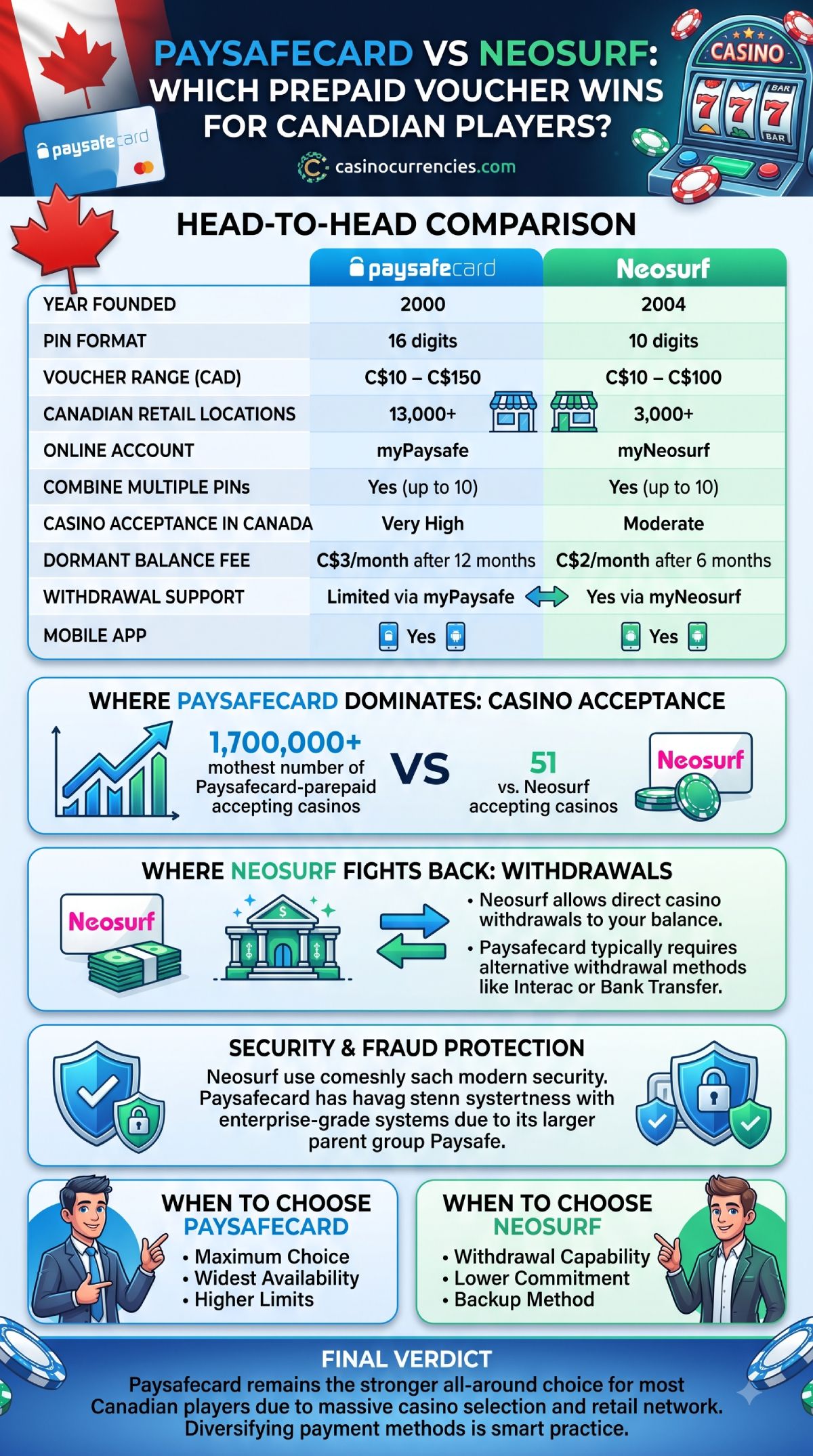
Head-to-Head Comparison
I've compiled the most critical factors Canadian players care about into a single table. Every data point here comes from my own testing or directly from each company's published terms for the Canadian market.
| Feature | Paysafecard | Neosurf |
|---|---|---|
| Year Founded | 2000 | 2004 |
| PIN Format | 16 digits | 10 digits |
| Voucher Range (CAD) | C$10 – C$150 | C$10 – C$100 |
| Canadian Retail Locations | 13,000+ | 3,000+ |
| Online Account | myPaysafe | myNeosurf |
| Combine Multiple PINs | Yes (up to 10) | Yes (up to 10) |
| Casino Acceptance in Canada | Very high | Moderate |
| Dormant Balance Fee | C$3/month after 12 months | C$2/month after 6 months |
| Withdrawal Support | Limited (via myPaysafe) | Yes (via myNeosurf) |
| Currency Conversion Fee | Up to 4% | Up to 4% |
| KYC Required | For myPaysafe account | For myNeosurf account |
| Mobile App | Yes | Yes |
A few numbers in that table deserve extra attention. The dormant fee difference is significant - Neosurf starts charging C$2 monthly after just six months of inactivity, while Paysafecard gives you a full year before the C$3 monthly fee kicks in. If you're an occasional user who buys a voucher every few months, that timeline matters for your wallet.
Casino Acceptance: Where Paysafecard Dominates
This is the category where the gap is widest. In my database of reviewed Canadian online casinos, Paysafecard appears as an accepted deposit method at roughly three times the rate of Neosurf. The brand recognition alone gives it a massive distribution advantage - casino operators know their players recognize the Paysafecard logo, so they prioritize integrating it.
For Canadian players specifically, I maintain an updated list of top-rated Paysafecard casinos that I've personally verified for licensing, payout reliability, and bonus fairness. Finding an equivalent list for Neosurf casinos is harder simply because fewer operators support it.
That said, Neosurf has been gaining ground. Several newer casino brands - particularly those targeting the European and Canadian markets simultaneously - have added Neosurf alongside Paysafecard. If this trend continues at its current pace, the acceptance gap could narrow considerably within the next two to three years.
Withdrawals: Where Neosurf Fights Back
Here's the one area where Neosurf genuinely outperforms its rival. Through a verified myNeosurf account, you can request casino withdrawals directly back to your Neosurf balance. It's not universally available at every casino, but the option exists and works at a growing number of sites.
Paysafecard withdrawals, by contrast, are extremely rare in the Canadian market. Most players who deposit with Paysafecard end up withdrawing through bank transfers, Interac, or another method entirely. I've always flagged this as Paysafecard's biggest practical weakness - a payment method that only works in one direction forces you to maintain a second withdrawal solution, which adds complexity.
If the ability to deposit and withdraw through the same channel is a priority for you, Neosurf holds a clear advantage here.
Security and Privacy
Both prepaid vouchers deliver the core privacy benefit that attracts most users: anonymous online payments without exposing bank or credit card details. From a security architecture standpoint, neither method introduces significant risk to the user. You're handing over a disposable PIN code, not persistent financial credentials.
However, Paysafecard edges ahead on fraud protection infrastructure. The company's integration with Paysafe Group gives it access to enterprise-grade fraud detection systems that monitor transactions across a US$150 billion annual payment volume. That's a scale of data that Neosurf, as a smaller independent operator, simply cannot match.
I've encountered exactly two instances of compromised Paysafecard PINs during my years of testing - both traced back to phishing sites impersonating legitimate retailers. Neosurf's fraud complaint record appears comparable, though the company publishes less detailed security reporting, which makes direct comparison difficult.
Budget Control and Spending Limits
Both payment methods excel at enforcing spending discipline, which is something I advocate strongly for all Canadian players. When you're working with a fixed prepaid voucher, you physically cannot overspend. That's a powerful constraint that credit cards and e-wallets don't provide.
The practical difference comes down to maximum voucher values:
- Paysafecard: C$150 per voucher, combine up to 10 for a C$1,500 ceiling
- Neosurf: C$100 per voucher, combine up to 10 for a C$1,000 ceiling
For recreational players depositing C$20 to C$50 per session, this difference is irrelevant. For higher-volume players, Paysafecard's higher ceiling provides more flexibility without requiring additional voucher purchases.
Availability Outside of Casinos
I recently wrote about Paysafecard's real-world utility beyond iGaming, and the range of merchants accepting it is genuinely impressive - Steam, PlayStation Store, Spotify, Skype, and hundreds of other digital platforms. Neosurf's non-gambling merchant network is noticeably thinner. If you want a prepaid voucher that doubles as a general-purpose online payment tool, Paysafecard is the more versatile option.
My Verdict: Which Should You Choose?
After all the testing, number-crunching, and real-money deposits I've made with both methods, here's my honest recommendation for Canadian players.
Choose Paysafecard if you want maximum casino selection, the widest retail availability across Canada, higher voucher limits, and a prepaid solution that works well beyond gambling sites. It's the safer, more established choice for the majority of players.
Choose Neosurf if withdrawal capability through the same payment channel is a dealbreaker for you, or if you prefer slightly lower minimum commitments and don't mind a smaller casino selection. It's a solid alternative that's improving steadily.
For most Canadian players reading this, Paysafecard remains the stronger all-around option. The retail network is four times larger, casino acceptance is significantly higher, and the brand's 24-year track record speaks for itself. But I'd never discourage anyone from keeping a Neosurf voucher as a backup - diversifying your payment methods is just smart financial practice, whether you're at the casino or anywhere else online.