
After five years of reviewing payment methods for the iGaming industry, I've answered the same Paysafecard questions hundreds of times. How do fees work? Can I withdraw? Is it regulated? So I decided to put everything into one definitive guide. Whether you're using Paysafecard at Canadian online casinos or for everyday purchases, this is every detail you need - straight from someone who's tested the system with real money across dozens of platforms.
Who Owns Paysafecard and Who Started It?
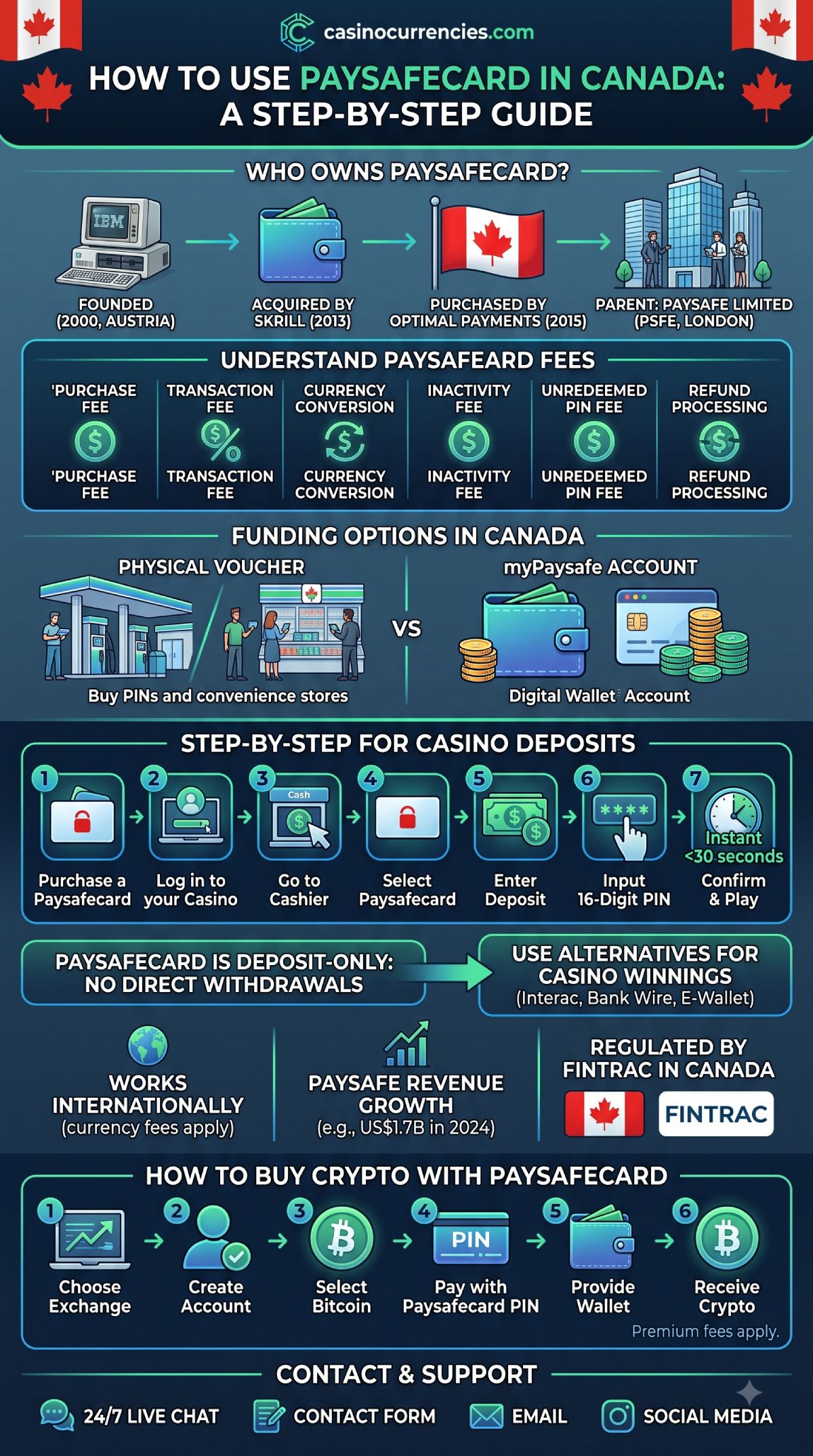
Paysafecard was founded in Vienna, Austria in the year 2000 by a group of four Austrian entrepreneurs, including Armin Sageder, who served as the first CEO. The original company was registered as paysafecard.com Wertkarten AG, with IBM Austria providing the initial technical infrastructure and hardware.
The product's history gets more interesting through a series of acquisitions. In 2013, digital wallet provider Skrill acquired Paysafecard. Then in 2015, Optimal Payments Group - a Canadian-founded company tracing its roots back to 1996 - purchased the entire Skrill Group for approximately €1.1 billion and rebranded everything under the Paysafe umbrella.
Today, Paysafecard operates as a subsidiary of Paysafe Limited (NYSE: PSFE), headquartered in London, England. Bruce Lowthers has served as CEO since 2022, with Dan Henson as chairman. The parent company employs roughly 3,300 people across 12 countries, processing payments through over 260 payment types in more than 40 currencies worldwide.
Does Paysafecard Charge Fees?
This is one of the most common questions I receive, and the answer requires some nuance. Purchasing a Paysafecard voucher and using it for a standard online payment is free at most retail outlets. The PIN itself costs nothing beyond its face value. However, several situational fees apply that every Canadian user should understand.
| Fee Type | Amount | When It Applies |
|---|---|---|
| Purchase fee | Free (usually) | Some third-party retailers add 3–5% markup |
| Transaction fee | Free | Standard online payments |
| Currency conversion | ~2% (up to 6% on exotic pairs) | When voucher currency differs from merchant currency |
| Inactivity fee | C$3/month | After 12 months of no transactions on a voucher |
| Unredeemed PIN fee | C$2.50 | If PIN isn't loaded to myPaysafe within 18 months |
| Refund processing | C$7.50 | Requesting a cash refund of remaining balance |
| myPaysafe top-up | Varies | Depends on the top-up method used |
My advice from a financial standpoint is straightforward: buy CAD-denominated vouchers, use them at CAD-processing merchants, and don't let balances sit idle. Follow those three rules and you'll pay zero fees in most cases.
How to Fund a Paysafecard Account in Canada
There are two ways to think about "funding" with Paysafecard, and the distinction matters.
Option 1: Buy a Physical Voucher
This is the classic method. Walk into any of the 13,000+ Canadian retail locations that sell Paysafecard - Couche-Tard, Petro-Canada, Shell, Shoppers Drug Mart, Jean Coutu, and many independent convenience stores. Choose a denomination between C$10 and C$150, pay cash or debit, and receive a receipt with your 16-digit PIN. That PIN is your payment credential.
Option 2: Fund a myPaysafe Account
If you register for a free myPaysafe account at paysafecard.com, you unlock additional functionality. You can load voucher PINs into the digital wallet, combine multiple PINs (up to 10 per transaction), and manage your balance online. Some regions also allow topping up via bank transfer or other methods, though availability varies by province.
Step-by-Step for Casino Deposits
- Purchase a Paysafecard voucher at a Canadian retailer
- Log into your online casino account
- Navigate to the cashier or deposit section
- Select Paysafecard from the payment methods list
- Enter the deposit amount (minimum C$10)
- Input your 16-digit PIN code
- Confirm the transaction - funds appear instantly
I've timed this process at dozens of Paysafecard casinos, and the average deposit takes under 30 seconds from PIN entry to playable balance.
How to Withdraw From Paysafecard
I'll be blunt here because too many guides dance around this: Paysafecard is primarily a deposit-only payment method. You cannot withdraw casino winnings directly back to a Paysafecard voucher PIN. This is a product-level limitation, not a casino policy.
However, there are workarounds through the Paysafe ecosystem.
If you have a verified myPaysafe account, a limited number of casinos can process withdrawals to that account balance. From there, you may be able to transfer funds to a linked bank account, though this feature's availability depends on your region and verification level.
For most Canadian players, the practical approach is to deposit with Paysafecard and withdraw through an alternative method such as Interac e-Transfer, bank wire, or another e-wallet. I always recommend setting up your withdrawal method before making your first deposit so there are no surprises when you're ready to cash out.
Does Paysafecard Work Internationally?
Absolutely. As of 2024, Paysafecard operates in approximately 50 countries with over 650,000 retail sales outlets worldwide. The service is particularly strong across Europe, where it originated, but has significant presence in North America, South America, and parts of the Middle East.
For Canadian travellers, the key consideration is currency. Your CAD voucher works internationally, but you'll face a currency conversion fee starting around 2% for major currency pairs (CAD to USD, CAD to EUR) and potentially climbing to 6% for less common currencies. From a cost perspective, I'd recommend buying vouchers in the local currency when travelling rather than converting from CAD.
Countries where Paysafecard is widely available include Canada, the United States, the United Kingdom, Germany, Austria, France, Spain, Italy, Australia, Brazil, Mexico, and Argentina, among many others.
Paysafe Stock Performance
Paysafe Limited trades on the New York Stock Exchange under the ticker PSFE. The company went public through a SPAC merger in 2021, and the stock's journey since then has been turbulent, to say the least.
Here's a snapshot of the financial picture:
| Metric | Value |
|---|---|
| Ticker | NYSE: PSFE |
| Market cap (April 2026) | ~US$442 million |
| Stock price (August 2026) | ~US$7.32 |
| 52-week high | US$15.02 |
| 52-week low | US$5.95 |
| All-time high | US$230.88 (January 2021) |
| Analyst consensus | Hold |
| Analyst price target | ~US$10.12 |
The stock has lost significant value from its SPAC-era highs. Analysts currently hold a mixed outlook, with a consensus "Hold" rating. Management has been focused on deleveraging and targets reducing net leverage to 3.5x by end of 2026. I'm not here to give investment advice - I'm a payments analyst, not a stockbroker - but the numbers tell a story of a company still proving its post-SPAC value thesis.
Paysafe Revenue
The parent company has shown consistent organic revenue growth despite the stock performance. Full year 2024 revenue came in at US$1.705 billion, representing a 6% increase year-over-year. Total payment volume for 2024 reached US$151.7 billion.
For 2025, reported revenue was approximately US$1.7 billion (flat on a reported basis due to a business disposition, but 5% organic growth). The company guided 2026 revenue between US$1.79 billion and US$1.83 billion, targeting 5–8% growth.
The iGaming vertical has been a particular bright spot, with North American iGaming volumes growing over 50% year-over-year during certain quarters. That's a number I pay close attention to professionally, and it confirms what I've seen firsthand - more Canadian casinos are integrating Paysafe products every quarter.
Does Paysafecard Report to Financial Regulators?
Yes, and this is important for Canadian users to understand. Paysafe Financial Services Limited is authorized and regulated by the UK's Financial Conduct Authority (FCA) under registration number FRN 900015. In Canada specifically, the company is licensed as a foreign Money Services Business with FINTRAC - the Financial Transactions and Reports Analysis Centre of Canada.
FINTRAC is Canada's financial intelligence unit, responsible for detecting and deterring money laundering and terrorist financing. Any Money Services Business operating in Canada must comply with the Proceeds of Crime (Money Laundering) and Terrorist Financing Act (PCMLTFA). Paysafe is also registered as a Money Services Business with Revenu Québec for operations in that province.
What does this mean for you practically? Paysafecard transactions above certain thresholds may be reported. If you register for a myPaysafe account, you'll go through KYC (Know Your Customer) verification - identity documents, proof of address, the standard compliance package. Anonymous voucher use without an account has lower transaction limits specifically because of these regulatory requirements.
Can You Buy Crypto With Paysafecard?
Yes, you can buy Bitcoin and other cryptocurrencies using Paysafecard, though not directly through Paysafe itself. Several third-party exchanges and peer-to-peer platforms accept Paysafecard as a deposit method for purchasing crypto.
How to Buy Bitcoin With Paysafecard
- Choose a reputable exchange that accepts Paysafecard - platforms like Paybis, Swapped.com, and several P2P marketplaces support it
- Create an account and complete any required KYC verification
- Select Bitcoin (BTC) as your target cryptocurrency
- Choose Paysafecard as your payment method
- Enter the amount and your 16-digit voucher PIN
- Provide your Bitcoin wallet address for delivery
- Confirm the transaction - most platforms deliver BTC within minutes
A few honest warnings from my side. Without a registered myPaysafe account, transaction limits on vouchers can be quite restrictive. Exchange rates on these platforms often include premiums of 5–15% above market price, which is the cost of the privacy and convenience Paysafecard provides. Always use regulated, reputable exchanges and never share your PIN on unverified platforms. The crypto space attracts scammers, and prepaid voucher PINs are a favourite target.
How to Contact Paysafecard
Paysafecard offers several support channels for Canadian users:
- Live chat: Available 24/7 through the virtual assistant "Lara" on paysafecard.com - click the chat icon in the bottom-right corner
- Contact form: Submit a request through the support section at paysafecard.com/support/contact-us
- Email: info[at]paysafecard.com for general inquiries
- Social media: Active support via Facebook (facebook.com/paysafecard), Twitter/X ([at]paysafecard), and Instagram ([at]paysafecard)
- Corporate contact (Paysafe Group): pr[at]paysafe.com for media inquiries
- Mailing address: Paysafe Group, 1st Floor, 2 Gresham Street, London, EC2V 7AD, United Kingdom
In my experience, the live chat is the fastest route for account-specific issues. The contact form yields a response within 24–48 hours. For urgent matters like a compromised PIN or locked account, I'd recommend starting with live chat and escalating from there.
What Currencies and Payment Options Are Available?
Paysafecard vouchers are issued in approximately 28 currencies worldwide. For Canadian users, the default is CAD, but the broader ecosystem supports a wide range of options.
Supported Currencies
The major currencies available include CAD, USD, EUR, GBP, AUD, CHF, NZD, CZK, DKK, HUF, NOK, PLN, RON, SEK, MXN, BRL, ARS, KWD, and several others depending on the country of purchase.
Payment Methods Within the Paysafe Ecosystem
The parent company Paysafe Group operates multiple payment brands that interconnect:
- Paysafecard - prepaid voucher payments via 16-digit PIN
- PaysafeCash - barcode-based cash payments at retail locations
- myPaysafe - digital wallet for managing voucher balances
- Skrill - digital wallet with broader transfer capabilities
- Neteller - digital wallet popular in the iGaming sector
- PaysafeGo - newer mobile-first digital wallet with virtual Mastercard
This ecosystem means a Paysafecard user has pathways into multiple digital wallet products if they need broader functionality. I've used this interconnection myself - loading a Paysafecard balance into myPaysafe and then leveraging other Paysafe products for withdrawals or transfers that the voucher alone can't handle.
How Long Do Paysafecard Payments Take?
Speed is one of Paysafecard's strongest selling points. Here's the breakdown by transaction type:
| Transaction Type | Processing Time |
|---|---|
| Online purchase / casino deposit | Instant (under 30 seconds) |
| Loading PIN to myPaysafe account | Instant |
| Currency conversion | Instant (applied automatically) |
| Casino withdrawal (via myPaysafe) | 1–5 business days (casino-dependent) |
| Bank transfer from myPaysafe | 2–5 business days |
| Refund from merchant | Varies (to myPaysafe balance) |
For deposits at online casinos, the experience is genuinely instant. I've tested this across more than 40 platforms, and I've never waited more than a few seconds for funds to appear. It's one of the reasons Paysafecard remains a top recommendation in my casino payment reviews.
Can a Paysafecard Payment Be Reversed?
This is where things get tricky, and I want to be completely transparent. Paysafecard payments are generally final. Once you authorize a transaction by entering your PIN and confirming, the funds are deducted from your voucher balance immediately with no built-in chargeback mechanism like credit cards offer.
If you need a refund, the process depends entirely on the merchant. Some merchants will issue refunds to your myPaysafe account balance rather than back to the original PIN. Others may offer store credit or alternative refund methods. Casino deposits are almost never reversible once processed - the funds are in your casino account and subject to that operator's withdrawal policies.
For disputed or unauthorized transactions, you'll need to contact Paysafecard's support team directly. They can investigate cases of fraud or compromised PINs, but the resolution process is slower and less consumer-friendly than a traditional credit card dispute.
How to Cancel a Paysafecard Payment
You cannot cancel a Paysafecard payment after it has been processed. The transaction is final the moment you confirm it. This is fundamentally different from credit card payments or bank transfers, where cancellation windows may exist.
If you need to stop a payment, your only options are:
- Before confirmation: Simply don't enter the PIN or close the payment window before completing the transaction
- After confirmation: Contact the merchant directly to request a refund - Paysafecard itself cannot reverse completed merchant transactions
- Unauthorized transactions: Report immediately to Paysafecard support for investigation and potential balance recovery
This no-cancellation design is actually part of what makes Paysafecard attractive to merchants and casinos - there's no chargeback risk. But as a consumer, it means you need to be absolutely certain before you confirm any transaction.
Does Paysafecard Have a Mobile App?
Yes. Paysafecard offers a mobile app available for both iOS (App Store) and Android (Google Play). The app provides several useful features for managing your prepaid payments on the go.
Core app features include balance checking for active voucher PINs, transaction history across all your payments, a retail store locator using GPS to find the nearest Paysafecard sales point, barcode scanning for quick PIN entry, myPaysafe account management, and push notifications for payment confirmations.
The app also integrates with PaysafeCash, allowing you to generate barcodes for cash payments at participating retailers. For Canadian users, the store locator is particularly helpful since the retail network spans over 13,000 locations and the app filters by proximity and voucher availability.
I'll note that the app's user reviews are mixed - some users report occasional login issues and interface glitches. But for basic balance management and finding retailers, it does the job competently. The newer PaysafeGo wallet app offers a more polished mobile experience if you're looking for a full digital wallet rather than just voucher management.
Final Thoughts
Paysafecard has built a remarkably specific niche in the payments world: anonymous, prepaid, instant online payments with zero exposure of personal banking data. After years of testing it across the Canadian iGaming landscape, I can confirm it delivers on that promise consistently.
The limitations are real - no direct withdrawals, no payment cancellations, and fees that can catch inattentive users off guard. But if you understand the product for what it is and use it within its design parameters, Paysafecard remains one of the most secure and straightforward deposit methods available to Canadian players.
For my complete, regularly updated list of verified casinos that accept this payment method, visit my Paysafecard casino reviews.