
I'll be blunt with you — over 16 million North Americans fall victim to identity fraud every single year. And with global financial losses from fraud hitting C$17 billion in 2024 alone, the e-wallet you use for online gambling is only as safe as the precautions you take around it. MiFinity has built a genuinely robust security infrastructure, but no platform can protect you from yourself. This guide is about closing the gaps that scammers exploit.
How MiFinity Protects Your Account
Before I get into what you need to do, let's acknowledge what MiFinity already does behind the scenes. The platform earned its ISO 27001 certification in February 2024, which is the international gold standard for information security management. That's not a marketing badge — it requires third-party audits and continuous compliance monitoring.
Here's the security stack working in your favour:
- SSL Encryption: Every transaction and data transfer on the platform is encrypted with Secure Socket Layer technology, making interception virtually impossible during transmission
- PCI DSS Level 1 Compliance: MiFinity meets the highest tier of Payment Card Industry security standards, meaning their systems undergo regular external audits
- Two-Factor Authentication (2FA): Every login and sensitive transaction requires a secondary verification code sent to your registered mobile device
- Strong Customer Authentication (SCA): In line with the European PSD2 directive, MiFinity requires at least two forms of identity verification before processing payments
- 3D Secure 2: Card deposits trigger an additional authentication layer through your bank
- AI-Powered Fraud Detection: A dedicated fraud team operates advanced monitoring tools that scan for suspicious activity across the platform in real time
- Automatic Session Timeout: After a period of inactivity, MiFinity logs you out automatically to prevent unauthorized access from an unattended device
That layered approach is why there are no publicly documented incidents of the MiFinity platform itself being breached. The vulnerabilities almost always sit on the user side — and that's exactly where scammers aim.
Common MiFinity Scams Targeting Canadian Players
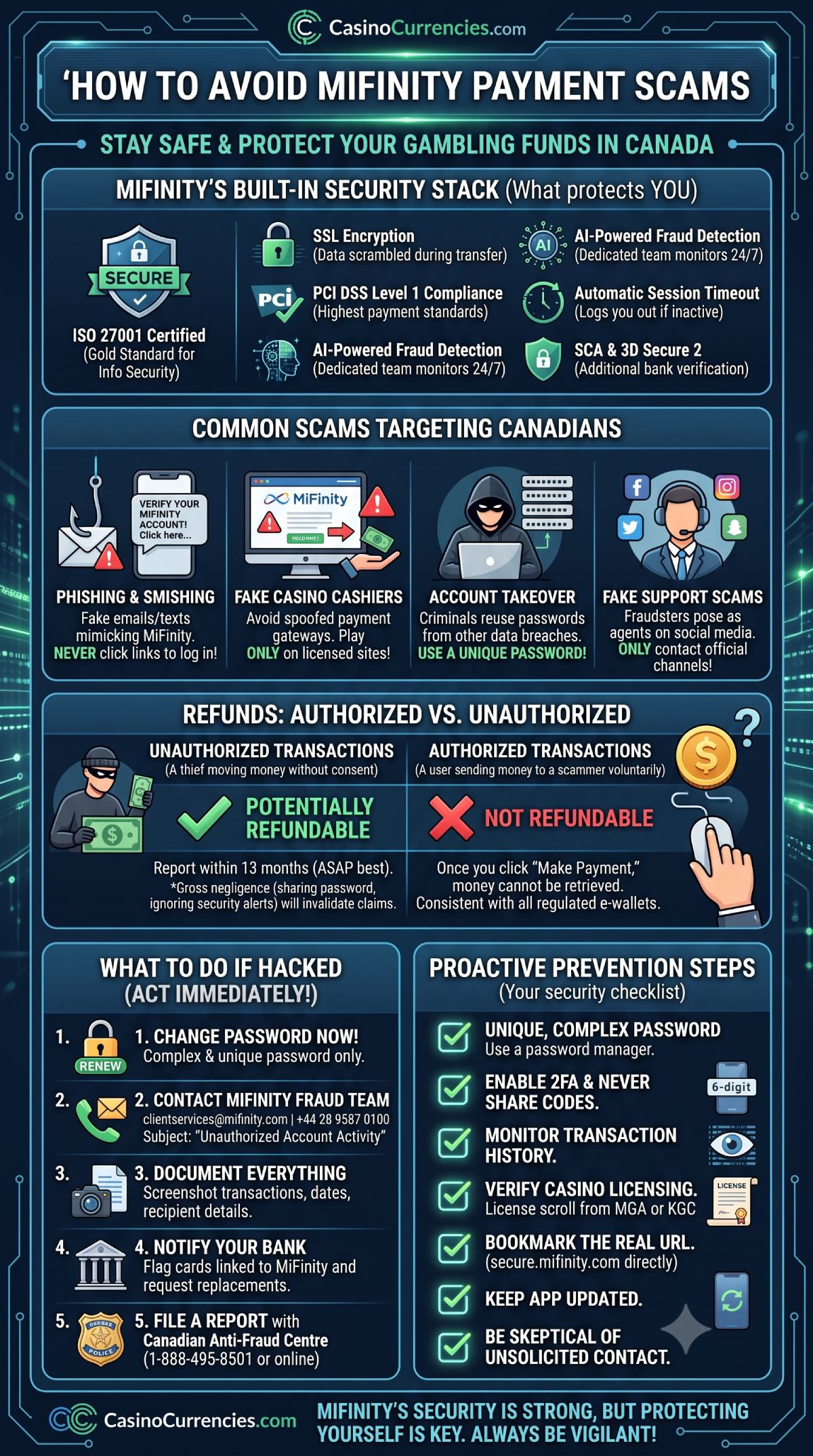
Understanding the attack vectors is half the battle. Here are the most frequent scam types I've tracked in the iGaming payments space that directly affect MiFinity users.
Phishing Emails and SMS (Smishing)
Fraudsters send emails or text messages that mimic MiFinity's branding, asking you to "verify your account" or "confirm a suspicious transaction" through a fake link. The page looks identical to MiFinity's login screen. You enter your credentials, and now the scammer has your password.
A critical fact to remember: MiFinity will never ask you for your full password, complete card numbers, or bank account numbers via email, phone, chat, or SMS. They will also never send unprompted messages requesting personal account information or ask you to transfer money to another party.
Fake Casino Cashier Scams
Some fraudulent casino sites claim to support MiFinity deposits but redirect you through a spoofed payment gateway. Your funds go to the scammer's wallet, not the casino's merchant account. Always verify you're playing at a licensed operator before connecting your MiFinity e-wallet.
Account Takeover Attacks
This happens when a criminal obtains your login credentials — often through data breaches on other platforms where you reused the same password. They access your MiFinity account, change recovery details, and drain your balance.
Fake Customer Support
Scammers sometimes pose as MiFinity support agents on social media or third-party forums, offering to "resolve" account issues. They'll ask for your login details or verification codes under the guise of helping.
Does MiFinity Refund Money if You're Scammed?
This is the question I get most often, and the honest answer depends on one crucial distinction: was the transaction authorized or unauthorized?
- Unauthorized transactions — where someone accessed your account without your consent and moved funds — are covered under MiFinity's terms. According to their conditions, if an unauthorized payment results in a financial loss to you, MiFinity will refund the payment amount including all deducted fees as soon as practicable. You must report the unauthorized activity within 13 months of the transaction date, though reporting within one week gives you the strongest position for recovery.
- Authorized transactions — where you voluntarily sent money, even if you were deceived into doing so — are a different story entirely. Once you click "Make Payment" and the transfer processes, MiFinity cannot retrieve those funds. This is consistent with how every regulated e-wallet operates. If you willingly sent C$500 to a scammer posing as a casino bonus agent, that money is gone from MiFinity's perspective.
There is one critical exception that limits your refund eligibility even for unauthorized transactions. If MiFinity determines that you acted with gross negligence — for example, sharing your password, ignoring security warnings, or failing to protect your login credentials — you bear full liability for all losses. The platform takes the position that 2FA and SCA exist specifically to prevent unauthorized access, so bypassing or ignoring those tools weakens your claim significantly.
For card-funded deposits, you retain chargeback rights through your card issuer. However, MiFinity's terms state chargebacks should only be exercised for genuinely unauthorized card use, not for disputes with merchants or gambling losses.
What to Do If Your MiFinity Account Is Hacked
Speed is everything. Every minute you delay gives the attacker more time to drain funds or lock you out. Follow this sequence immediately:
- Change your password now. Log in at secure.mifinity.com, navigate to your profile, and update your password immediately. Choose something complex that you haven't used on any other platform.
- Contact MiFinity's fraud team. Email clientservices[at]mifinity.com with the subject line clearly stating "Unauthorized Account Activity." Include your full name, registered email, and a description of the suspicious transactions. Phone support at +44 28 9587 0100 during business hours can escalate urgent cases faster.
- Document everything. Screenshot any unauthorized transactions visible in your transaction history. Note the dates, amounts, and recipient details. This evidence strengthens your refund claim.
- Check your linked payment methods. If the attacker added new cards or bank accounts to your MiFinity profile, report those additions in your communication with the fraud team.
- Secure your email account. If your MiFinity password was compromised, assume your email might be too. Change that password and enable 2FA on your email provider immediately.
- Notify your bank. If cards linked to your MiFinity account were used fraudulently, contact your Canadian bank or credit union to flag those cards and request replacements.
- File a report with the Canadian Anti-Fraud Centre. Reach them at 1-888-495-8501 or through their online reporting tool. This creates an official record that supports any subsequent dispute resolution.
MiFinity reserves the right to suspend or restrict your account if they detect suspicious activity on their end. If your account gets restricted during an investigation, the fraud team will contact you via your registered email. Check your junk folder if you haven't heard back — that's a surprisingly common issue reported by users.
Proactive Steps to Prevent MiFinity Scams
Prevention always costs less than recovery. These practices take minutes to implement but can save you thousands of dollars in potential losses.
- Use a unique, complex password. Never recycle passwords from other platforms. A password manager eliminates the excuse of "I can't remember unique passwords for every site."
- Enable 2FA and never share verification codes. That six-digit SMS code is the last wall between a scammer and your money. No legitimate MiFinity employee will ever ask you for it.
- Monitor your transaction history regularly. Log into your account or app at least weekly and review every transaction. Catching unauthorized activity early dramatically improves your recovery chances.
- Verify casino legitimacy before depositing. Only use your MiFinity e-wallet at casinos licensed by recognized regulators — the MGA, Kahnawake Gaming Commission, or Curaçao eGaming. A five-minute licence check can prevent a catastrophic loss.
- Bookmark the real MiFinity URL. Always access your account through secure.mifinity.com directly or the official app. Never click login links from emails or messages, even if they look authentic.
- Keep your app updated. MiFinity regularly pushes security patches to their iOS and Android apps. Running outdated versions leaves known vulnerabilities unpatched.
- Be skeptical of unsolicited contact. If someone reaches out claiming to be from MiFinity — through social media, forums, messaging apps, or phone — assume it's a scam until proven otherwise. Initiate contact yourself through official channels instead.
Can MiFinity Freeze a Scammer's Account?
Yes. MiFinity's terms give the company broad authority to suspend or terminate any account involved in fraudulent activity. Their internal fraud team monitors transactions in real time using AI-driven tools. If you report a scammer who also holds a MiFinity account, the platform can restrict that account and investigate.
However, recovery of funds from a frozen scammer account is not guaranteed. The investigation process, regulatory requirements, and cross-border legal complexities all affect whether your specific funds can be traced and returned. Report early, provide detailed evidence, and maintain communication with the fraud team for the best possible outcome.
Final Word
MiFinity's security infrastructure is genuinely strong — FCA regulation, ISO 27001, PCI DSS Level 1, and AI fraud monitoring put it well ahead of many competitors in the e-wallet space. But that architecture protects the platform. Protecting yourself requires active participation. The scammers targeting Canadian casino players aren't trying to break through MiFinity's firewalls — they're trying to get you to hand over the keys voluntarily.
Don't make it easy for them.