
Canadians lost over C$704 million to fraud in 2025 - the worst year on record - and the Canadian Anti-Fraud Centre estimates that figure represents only 5% to 10% of actual losses. Prepaid payment methods like Paysafecard are attractive targets for scammers precisely because of the feature that makes them appealing to legitimate users. Once a PIN code is shared, the transaction is essentially irreversible. I've spent years reviewing Paysafecard casinos in Canada and have personally encountered phishing attempts, fake support pages, and cleverly disguised scam operations targeting prepaid voucher users.
This guide covers every Paysafecard scam type I've documented, what to do if you're victimized, and how to protect yourself before it happens.
The Most Common Paysafecard Scams in Canada
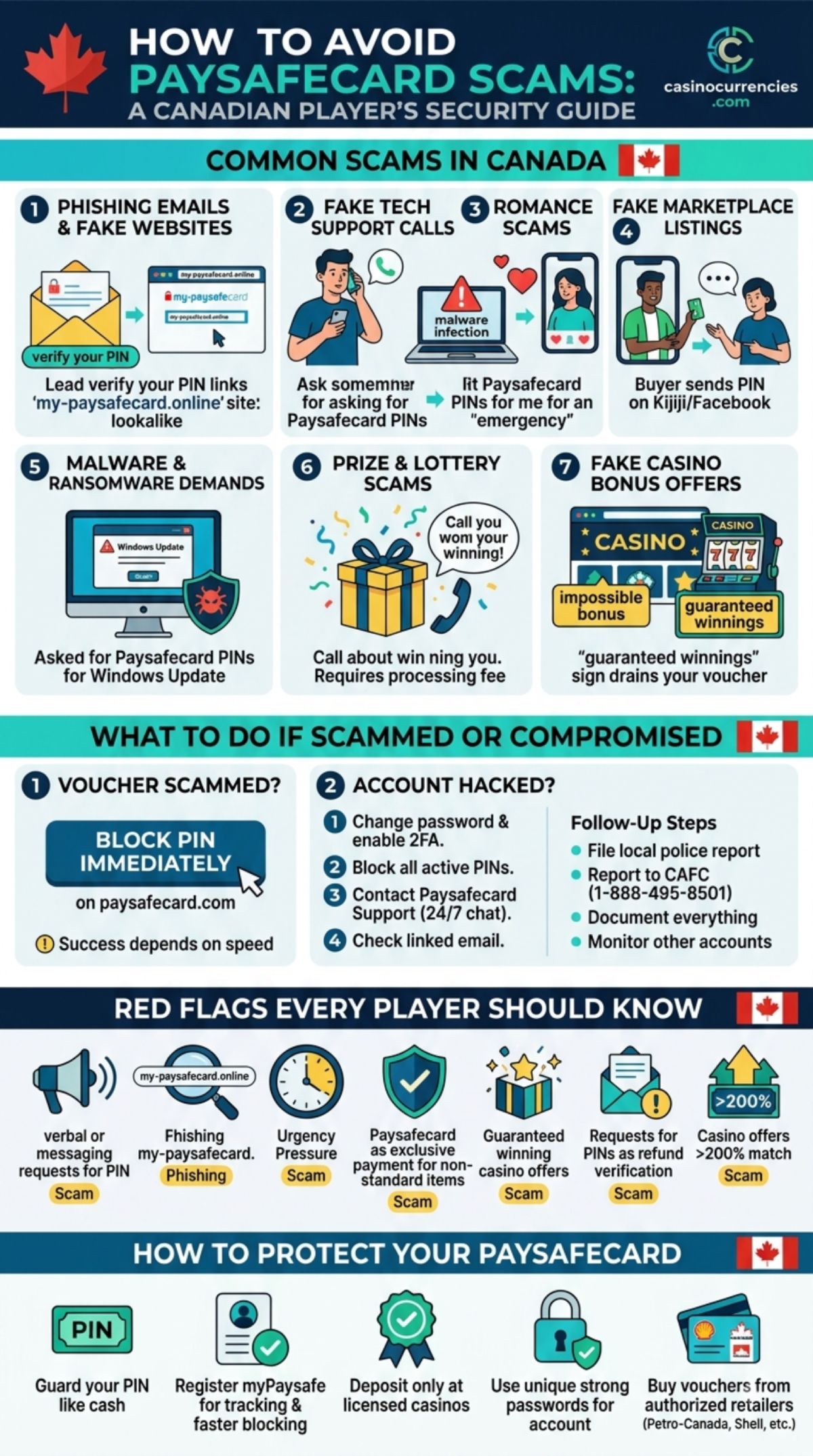
Scammers have developed remarkably sophisticated methods to separate Canadians from their Paysafecard PINs. After tracking fraud reports and user complaints across iGaming forums, consumer protection databases, and my own reader correspondence, I've identified seven primary scam categories.
Phishing Emails and Fake Websites
This is the single most prevalent Paysafecard scam, and Paysafecard themselves acknowledge it publicly on their security pages. Fraudsters send emails mimicking official Paysafecard branding, claiming your account needs verification, your PIN is expiring, or you've won a promotional reward. The email contains a link to a convincing replica of the Paysafecard website where you're prompted to enter your 16-digit PIN or myPaysafe login credentials.
I've seen phishing domains like "my-paysafecard.online" - registered just days before being used in scam campaigns - that mirror the official site almost pixel-for-pixel. The giveaway is always the URL. Legitimate Paysafecard communications only come from paysafecard.com domains, never from third-party addresses or recently registered lookalikes.
Fake Tech Support Calls
Paysafecard has documented this scam extensively. A caller claims to be from Microsoft, Apple, or your internet provider, insisting your computer is infected with malware or your account is compromised. The "solution" requires you to purchase Paysafecard vouchers and read the PIN codes over the phone as "payment" for the repair service. No legitimate tech company will ever request payment via prepaid voucher PINs. Full stop.
Romance and Relationship Scams
Relationship scams cost Canadians over C$63.3 million in 2025 alone, and prepaid vouchers are a favourite payment method for romance scammers because the transactions can't be reversed or easily traced. The pattern is consistent: weeks or months of emotional connection building on dating apps or social media, followed by an "emergency" requiring financial help - and the scammer specifically requests Paysafecard codes because they're "the easiest way to send money quickly."
Fake Online Marketplace Listings
This one hits close to the iGaming community. Scammers post attractive listings for electronics, gaming gear, concert tickets, or casino bonus packages on classified sites like Kijiji, Facebook Marketplace, or even niche forums. The seller insists on Paysafecard as the only accepted payment. You send the PIN, and the product never arrives. One well-documented case involved a scammer creating a fake escrow service using a domain like "[at]safely-paysafecard.com" to intercept PIN codes during marketplace transactions.
Malware and Ransomware Demands
Paysafecard has publicly warned about malware that displays fake "Windows Update" screens threatening data loss unless the victim purchases a "paid Windows licence" via Paysafecard PIN. Similar ransomware variants lock your files and demand Paysafecard codes as ransom. This should trigger an immediate red flag - neither Microsoft nor any operating system vendor accepts Paysafecard as a licensing payment method.
Prize and Lottery Scams
A caller or email claims you've won a significant cash prize, but collecting it requires a "processing fee" or "tax prepayment" via Paysafecard vouchers. The fee might be C$200 to C$500, positioning it as a small investment against a supposedly massive payout. Legitimate lotteries never require upfront payment to claim winnings. I've received reports from Canadian readers targeted by these scams specifically because they had online casino accounts - the scammers know their targets are comfortable with digital payments.
Fake Casino Bonus Offers
As someone who reviews casino payment methods professionally, this category concerns me most. Scammers create fraudulent casino websites or impersonate legitimate ones, advertising impossible bonus offers - "500% match bonus with Paysafecard deposits" or "guaranteed winnings on first deposit." The site collects your Paysafecard PIN during the "deposit" process and drains the voucher balance instantly. I maintain a verified list of legitimate Paysafecard casinos precisely to help Canadian players avoid these traps.
Does Paysafecard Refund Money If You're Scammed?
Here's the hard truth that every Paysafecard user needs to internalize: once a PIN code is shared and the balance is spent, recovering those funds is extremely unlikely. Paysafecard operates on a prepaid voucher model without the chargeback protections that credit cards provide. There is no built-in buyer protection program, and the anonymous nature of PIN-based payments makes tracing stolen funds difficult.
That said, there is one scenario where recovery is possible. If you realize your PIN has been compromised before the scammer has used it, you can block the PIN immediately through the Paysafecard balance check tool at paysafecard.com. Enter the 16-digit code, and if you've blocked it in time, the system will display an error message confirming the PIN is locked. Once successfully blocked, you can request a refund of the remaining balance to your bank account.
The critical variable here is speed. The window between a scammer obtaining your PIN and draining its balance can be measured in minutes, sometimes seconds. That's why I always tell my readers: if you even suspect your PIN has been exposed, block it first and investigate second. Those few minutes of verification can be the difference between saving your money and losing it entirely.
For cases where the balance has already been spent, Paysafecard's anti-fraud team can be reached at antifraud[at]paysafecard.com. They can investigate the transaction, and while they cannot guarantee fund recovery, they cooperate with law enforcement in fraud cases. Having a police report significantly strengthens your case.
What to Do If Your Paysafecard Account Is Hacked
A compromised myPaysafe account is a different situation from a stolen voucher PIN, and it requires a more comprehensive response. If someone gains access to your registered account, they can potentially access multiple stored PINs, your transaction history, and personal details submitted during KYC verification.
Immediate Steps (Do These First)
- Change your password immediately - If you can still access the account, update your password to something completely new and enable two-factor authentication if available
- Block all active PINs - Check every voucher balance linked to your account and block any that still carry funds
- Contact Paysafecard support - Use the live chat at paysafecard.com (available 24/7 through the virtual assistant) or submit an urgent request through the contact form explaining the unauthorized access
- Check linked email - If the hacker changed your account email, contact support immediately to reclaim ownership using your original registration details
Follow-Up Steps (Within 24–48 Hours)
- File a police report - Visit your local Canadian police service or file online through your provincial reporting system. The report number is essential for any recovery claim
- Report to the Canadian Anti-Fraud Centre - Call 1-888-495-8501 or report online at antifraudcentre-centreantifraude.ca. The CAFC collects intelligence that helps identify fraud patterns
- Document everything - Screenshot your transaction history, save all emails related to the breach, and keep a written timeline of events. This documentation is crucial for any investigation
- Monitor your other accounts - If you used the same password elsewhere (which you shouldn't, but many people do), change those passwords immediately. A compromised myPaysafe account may indicate a broader credential breach
What Paysafecard Will Do
Paysafecard's fraud investigation team will review the unauthorized transactions on your account. They can freeze the account to prevent further losses, trace the transactions to identify where funds were sent, and potentially recover balances that haven't been fully spent. Response time varies, but most users report initial contact within 24–48 hours for urgent fraud reports.
Red Flags Every Canadian Player Should Recognize
After years in this industry, I've developed a mental checklist that has never steered me wrong. If any of these apply to a situation you're facing, walk away.
| Red Flag | What It Means |
|---|---|
| Someone asks you to share a PIN code verbally or via message | Legitimate businesses never request PINs outside their payment checkout |
| A website URL doesn't match paysafecard.com exactly | Phishing site - even one character difference means it's fake |
| Urgency pressure ("pay now or lose your account/prize/data") | Scammers manufacture time pressure to prevent rational evaluation |
| Payment exclusively via Paysafecard for non-standard purchases | Scammers prefer irreversible payment methods |
| "Guaranteed winning" casino offers | No legitimate casino guarantees outcomes |
| Requests for Paysafecard codes as "refund verification" | Paysafecard never requests PINs to process refunds |
| Unsolicited emails about account issues | Paysafecard contacts users through their registered account, not random emails |
| Casino bonus offers exceeding 200% match | Almost certainly fraudulent or attached to impossible wagering requirements |
How to Protect Your Paysafecard From Scammers
Prevention is dramatically more effective than recovery in the prepaid voucher space. Here are the practices I follow personally and recommend to every Canadian player.
- Guard your PIN like cash. A Paysafecard PIN is the digital equivalent of cash in an envelope. Once someone has the 16-digit code, they have your money. Never photograph PINs with a smartphone, never store them in unencrypted text files, and never share them with anyone outside of a verified merchant checkout process.
- Register for a myPaysafe account. The account gives you balance tracking, transaction alerts, and the ability to block PINs quickly if something goes wrong. Unregistered voucher users have far fewer recovery options. The KYC verification process adds a layer of identity protection that anonymous voucher use simply cannot provide.
- Only deposit at verified, licensed casinos. I cannot stress this enough. Before entering a Paysafecard PIN at any online casino, verify the operator's licensing credentials independently. Check for valid licenses from recognized authorities like the Malta Gaming Authority, the UK Gambling Commission, or provincial Canadian regulators. My Paysafecard casino reviews verify these credentials for every listed operator.
- Use unique, strong passwords. Your myPaysafe account password should not be reused from any other service. A password manager generates and stores strong unique credentials without requiring you to memorize them. This single practice prevents the majority of account takeover fraud.
- Enable email filters. Paysafecard themselves recommend setting up email rules that automatically flag or separate external emails into a distinct folder. This makes phishing attempts easier to spot because legitimate Paysafecard communications will come from their verified domain.
- Buy vouchers only from authorized retailers. In Canada, that means established chains like Couche-Tard, Petro-Canada, Shell, and Shoppers Drug Mart. Never purchase Paysafecard PINs from individuals, social media sellers, or unverified online resellers. The PIN could be partially used, stolen, or completely fake.
Where to Report Paysafecard Fraud in Canada
Reporting fraud isn't just about your own case - the Canadian Anti-Fraud Centre uses report data to identify patterns and take down scam operations. Here's where to file reports.
- Canadian Anti-Fraud Centre (CAFC): 1-888-495-8501 or antifraudcentre-centreantifraude.ca
- Paysafecard Anti-Fraud Team: antifraud[at]paysafecard.com
- Paysafecard Support: Live chat or contact form at paysafecard.com/support/contact-us
- Local police: File a report through your municipal or provincial police service
- Competition Bureau of Canada: For deceptive marketing practices connected to scams
Since 2022, reported fraud losses in Canada have surpassed C$2.4 billion, and the CAFC, RCMP, and Competition Bureau have partnered on a national anti-fraud strategy launched in early 2026. Your individual report contributes to that effort. Research from Payments Canada found that prepaid cards experienced an average of 10.5 fraud encounters per user over six months in 2025 - second only to cash. Those numbers only improve when victims come forward.
Final Thoughts
Paysafecard is a fundamentally secure payment method when used correctly. The 16-digit PIN system, the absence of shared banking data, and the prepaid spending cap all work in your favour as a consumer. The vulnerabilities emerge when that PIN leaves the legitimate payment ecosystem - when it's shared with a scammer, entered on a phishing site, or read aloud to someone pretending to be tech support.
The golden rule I've followed across five years of reviewing prepaid payment methods in the iGaming space is simple: your Paysafecard PIN should only ever be entered on a merchant's verified checkout page or within the official myPaysafe platform. Any request for a PIN outside of those two contexts is a scam. No exceptions, no matter how convincing the story.
Stay vigilant, report fraud when you encounter it, and always verify before you trust. Your money depends on it.