
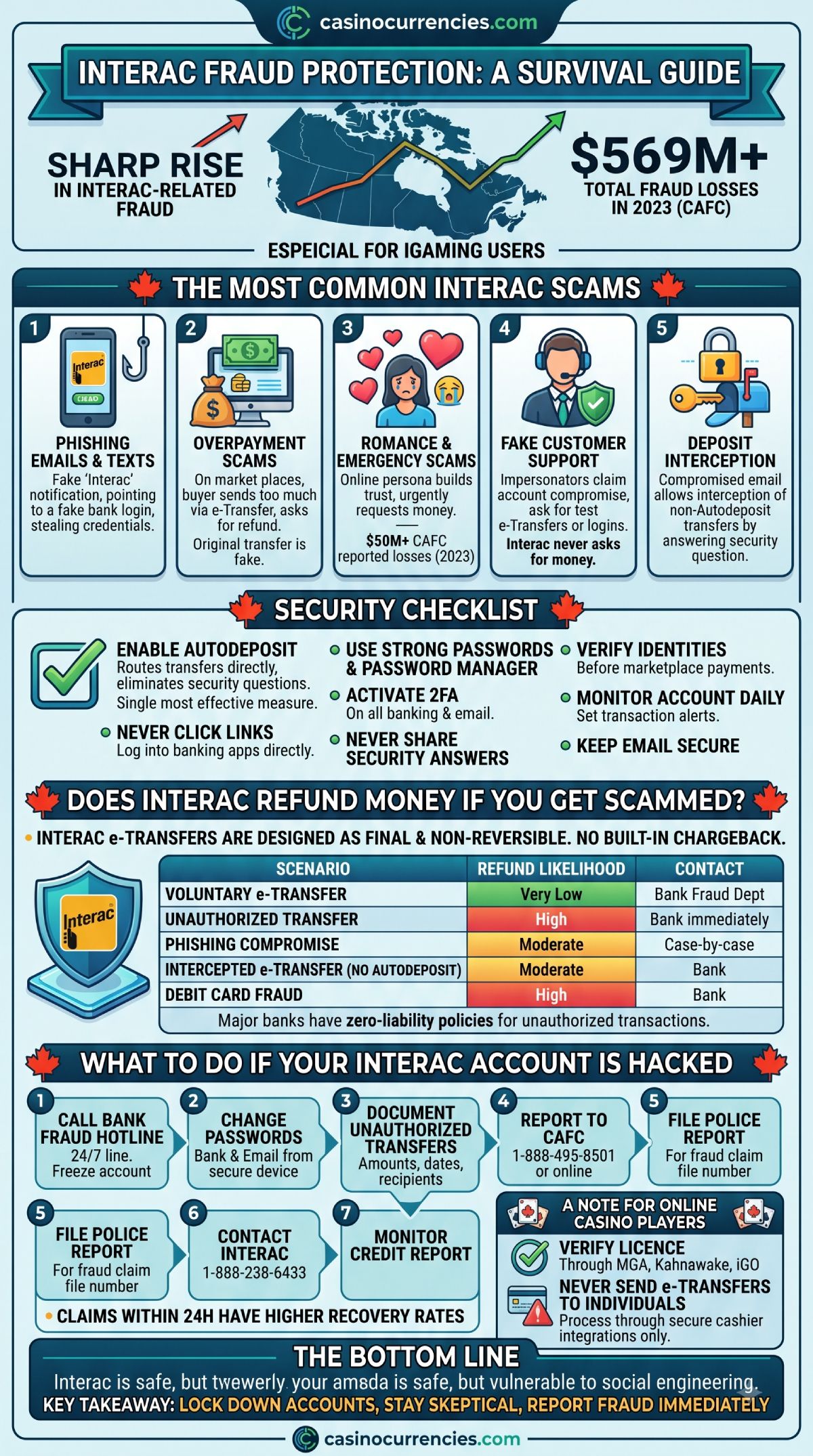
In my years covering payment security for the iGaming space, I have seen a sharp rise in Interac-related fraud targeting Canadian consumers. The Canadian Anti-Fraud Centre reported over C$569 million in total fraud losses in 2023, and a significant portion of those involved e-Transfer scams. Because Interac moves money instantly and irreversibly, it has become a favourite tool for fraudsters. Knowing how to protect yourself is not optional - it is essential whether you use Interac for groceries, rent, or funding your account at Interac casinos.
The Most Common Interac Scams in Canada
Scammers are creative, but most Interac fraud falls into a handful of repeating patterns. Here are the schemes I track most frequently.
Phishing Emails and Texts
You receive an email or SMS that looks like a legitimate Interac e-Transfer notification. The link leads to a fake banking login designed to steal your credentials. The Canadian Anti-Fraud Centre flags phishing as the most reported cyber fraud category in the country.
Overpayment Scams
Common on Kijiji and Facebook Marketplace. A buyer sends an e-Transfer for more than the agreed price, then asks you to refund the difference. The original transfer turns out to be fraudulent, and you lose the "refund" from your own funds.
Romance and Emergency Scams
A person you met online builds trust over weeks, then urgently needs money via Interac e-Transfer. Romance fraud accounted for over C$50 million in reported Canadian losses in 2023.
Fake Customer Support
Scammers impersonate Interac, your bank, or even an online casino's support team. They call or email claiming your account has been compromised and ask you to "verify" by sending a test e-Transfer or sharing your login credentials. Interac will never ask you to send money or share passwords.
Deposit Interception
If you use security questions instead of Autodeposit for e-Transfers, fraudsters who have compromised your email can intercept incoming transfers by answering the question before the intended recipient does.
How to Protect Yourself: A Security Checklist
I recommend every Canadian who uses Interac - especially those who deposit at online casinos - follow these steps.
- Enable Autodeposit on your bank account immediately. This eliminates security questions entirely and routes incoming e-Transfers directly into your account. It is the single most effective anti-fraud measure available.
- Never click links in e-Transfer emails. Instead, log into your banking app directly to check for pending deposits.
- Use unique, strong passwords for your online banking. A password manager makes this effortless.
- Activate two-factor authentication (2FA) on every banking app and email account you own.
- Never share security questions or answers with anyone, including people claiming to be from your bank.
- Verify buyer or seller identity before accepting marketplace payments. If a deal feels rushed or too generous, walk away.
- Monitor your account daily. Set up transaction alerts through your bank's app so you are notified of every debit in real time.
- Keep your email secure. A compromised email is the gateway to intercepted e-Transfers and phishing attacks.
Does Interac Refund Money If You Get Scammed?
This is the question I receive most often, and the answer is difficult. Interac e-Transfers are designed to be final and non-reversible once accepted. Unlike credit card transactions, there is no built-in chargeback mechanism. If you voluntarily sent money to a scammer via e-Transfer, Interac itself does not offer a refund.
However, your bank may intervene depending on the circumstances.
| Scenario | Refund Likelihood | Who to Contact |
|---|---|---|
| You sent an e-Transfer to a scammer voluntarily | Very low | Your bank's fraud department |
| Unauthorized e-Transfer from your account | High (bank liability) | Your bank immediately |
| Phishing led to compromised banking credentials | Moderate (case-by-case) | Your bank + Canadian Anti-Fraud Centre |
| Intercepted e-Transfer (no Autodeposit) | Moderate | Your bank's fraud team |
| Debit card used without authorization | High (zero-liability policy) | Your bank immediately |
Most major Canadian banks have zero-liability policies for unauthorized debit transactions. The challenge comes when you authorized the transfer yourself, even under deception - banks treat voluntary transfers differently from unauthorized access.
What to Do If Your Interac Account Is Hacked
If you suspect unauthorized access or fraudulent Interac transactions, act within minutes. Here is the exact sequence I advise.
- Call your bank's fraud hotline immediately. Every major bank has a 24/7 fraud line. Request an account freeze to stop further transactions.
- Change your online banking password and email password from a secure device - not the one that may be compromised.
- Review recent transactions and identify every unauthorized transfer. Document amounts, dates, and recipient details.
- File a report with the Canadian Anti-Fraud Centre at 1-888-495-8501 or through their online reporting tool. This creates an official record.
- File a police report with your local department. Some banks require a police file number before processing fraud claims.
- Contact Interac directly at 1-888-238-6433 to report the fraudulent e-Transfers. They can coordinate with your bank's investigation.
- Monitor your credit report through Equifax or TransUnion for any new accounts opened in your name.
Fraud claims filed within 24 hours have significantly higher recovery rates than those reported days later.
A Note for Online Casino Players
If you use Interac at online casinos, fake sites mimicking legitimate Interac casinos are a growing threat. Before depositing, verify the operator's licence through a recognized regulator (MGA, Kahnawake, or a provincial authority like iGO in Ontario).
Never send an Interac e-Transfer directly to an individual claiming to represent a casino. Legitimate operators process deposits through secure cashier integrations, not personal email addresses.
The Bottom Line
Interac is one of the safest payment networks in the world, but no system is immune to social engineering. The common thread in nearly every scam is human error - clicking a fake link, trusting a stranger, or skipping Autodeposit. Lock down your accounts, stay skeptical, and report fraud the moment you spot it.