
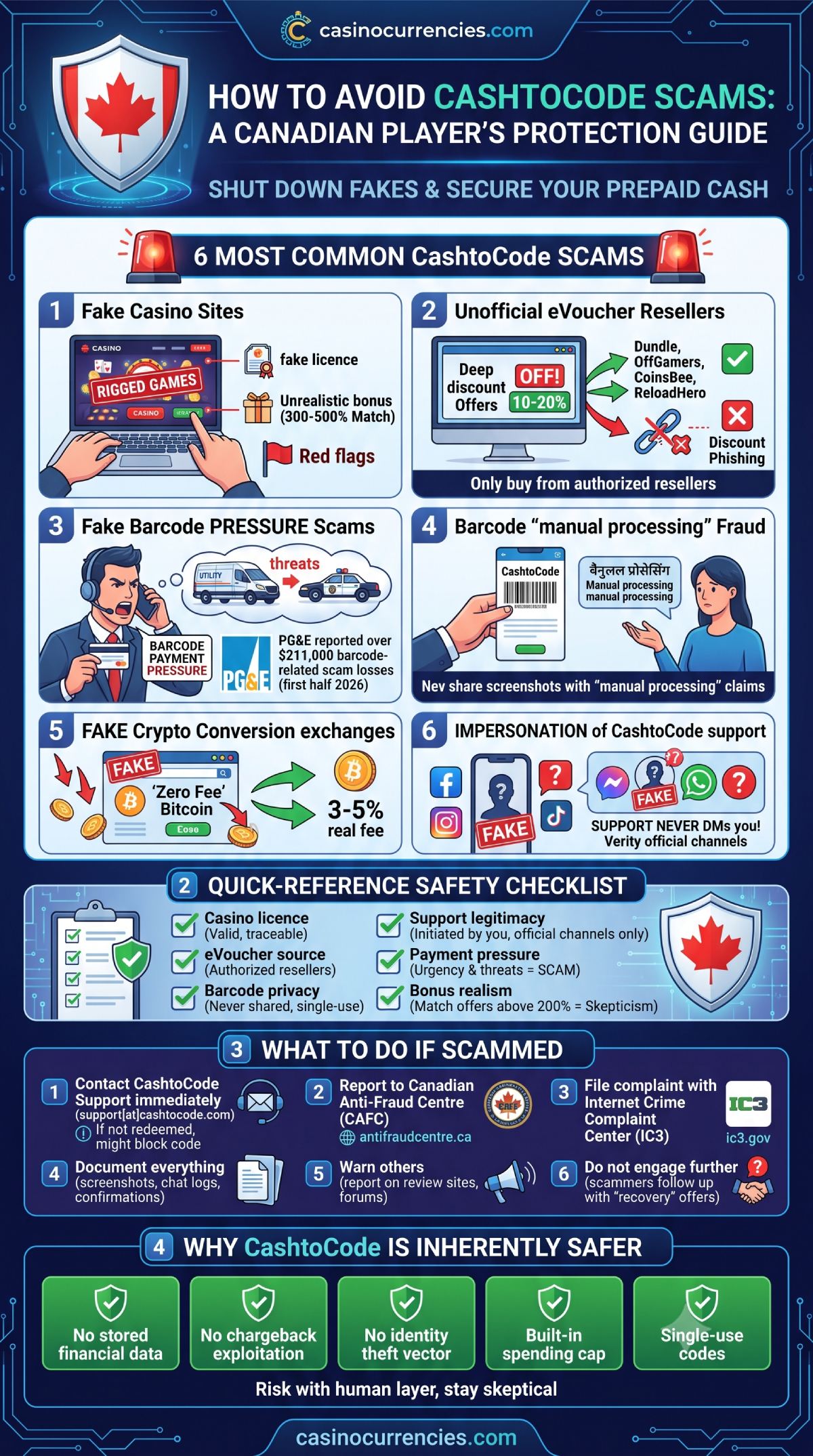
CashtoCode's core design is actually one of the safest payment architectures I've reviewed — single-use barcodes, no stored banking data, and no chargebacks mean the technology itself is inherently resistant to traditional payment fraud. But that doesn't mean scammers haven't found ways to exploit the people using it. After investigating reader reports and tracking fraud patterns across the prepaid voucher space for three years, I've identified the specific scam types that target CashtoCode users in Canada — and exactly how to shut each one down.
The 6 Most Common CashtoCode Scams
1. Fake Casino Sites Accepting CashtoCode
This is the most dangerous scam I see. Fraudsters build convincing casino websites that list CashtoCode as a deposit option. You deposit, play a few rigged games, and when you try to withdraw — delays, new verification demands, then silence. Because CashtoCode transactions are irreversible, your cash is gone.
Red flags to watch for:
- No verifiable gambling licence (or a fake licence logo that doesn't link to a regulatory database)
- Casino domain registered within the last 6 months
- Unrealistic bonuses (300–500% match offers with vague terms)
- No presence on independent review platforms like AskGamblers or Trustpilot
- Missing or broken responsible gambling tools
- Customer support only available through a contact form — no live chat, no phone
2. Unofficial eVoucher Resellers
CashtoCode officially authorizes only a handful of eVoucher resellers: Dundle, OffGamers, CoinsBee, and ReloadHero. I've found at least a dozen unofficial sites selling "CashtoCode eVouchers" at steep discounts — typically 10–20% below face value. These are almost always either invalid codes, already-redeemed codes, or phishing operations designed to collect your email and payment details.
How to protect yourself:
- Only buy from the four authorized resellers listed on CashtoCode's official website
- If a deal looks too good to be true (eVouchers at 15% off), it is
- Never buy CashtoCode codes from social media marketplaces, Telegram groups, or forums
- Verify the reseller URL matches the official domain exactly — one misspelled character is a phishing site
3. The "Send Me Your Barcode" Scam
This one targets players in gambling communities and forums. A scammer claims they can help you deposit at a casino that doesn't appear to accept CashtoCode, asking you to generate a barcode and share a screenshot or code. Once they have it, they redeem the barcode at a different merchant — and your money goes to their account instead.
The rule is simple:
- Never share a CashtoCode barcode or eVoucher code with anyone, ever
- Barcodes are single-use and tied to a specific transaction — sharing them is like handing over cash
- Legitimate casinos will never ask you to send a barcode screenshot to customer support for "manual processing"
4. Impersonation of CashtoCode Support
Scammers create fake CashtoCode support accounts on social media, forums, and messaging platforms. They reach out to users who post about transaction issues, offering to "resolve" the problem if you provide your voucher code, transaction ID, or personal details. Real CashtoCode support will never initiate contact through social media DMs.
How to verify legitimate support:
- Email: support[at]cashtocode.com (the only official support email)
- Phone (Austria): 0043 (0) 720 270 210
- Phone (Germany): 0049 (0) 30 530 515 72
- Help centre: info.cashtocode.com/help
- CashtoCode will never ask for your full voucher code via email or social media
5. Barcode Payment Pressure Scams
This mirrors the gift card scam pattern that cost North American consumers over $300 million in losses during 2025 alone. Someone posing as a government official, utility company, or tech support agent pressures you into generating a CashtoCode barcode and paying at a retail location to "settle a debt" or "avoid account suspension." PG&E alone reported over $211,000 in barcode-related scam losses in the first half of 2026.
Remember these facts:
- No government agency, utility company, or legitimate business will ever ask for payment via CashtoCode
- Urgency and threats of disconnection or arrest are hallmarks of scam calls
- If pressured to pay via barcode or voucher, hang up and contact the organization directly through their official number
6. Crypto Conversion Fraud
With CashtoCode increasingly used to buy cryptocurrency, scammers have set up fake exchange platforms that accept eVouchers but never deliver the crypto. They often advertise "zero fee" Bitcoin purchases via CashtoCode — a deal that doesn't exist in the legitimate market (real fees run 3–5%).
Stick to verified platforms:
- Crypto Voucher and BTCBIT.NET are established CashtoCode-accepting exchanges
- Avoid any platform promising fee-free crypto-for-voucher conversions
- Check the exchange's domain age, reviews, and regulatory status before redeeming any code
Quick-Reference Safety Checklist
Before completing any CashtoCode transaction, run through this list:
| Check | What to Verify |
|---|---|
| Casino licence | Valid licence number traceable to a real regulator (MGA, Curaçao, Kahnawake) |
| eVoucher source | Purchased from Dundle, OffGamers, CoinsBee, or ReloadHero only |
| Barcode privacy | Never shared with any person, support agent, or third party |
| Support legitimacy | Contact initiated by you, through official channels only |
| Payment pressure | Nobody legitimate demands CashtoCode payment under threat |
| Bonus realism | Match offers above 200% with low wagering warrant extreme skepticism |
| Site age | Casino domain less than 6 months old is a warning sign |
| Reviews | Check AskGamblers, Trustpilot, and at least one independent review site |
What to Do If You've Been Scammed
If you suspect fraud involving a CashtoCode transaction, act fast:
- Contact CashtoCode support immediately at support[at]cashtocode.com — if the code hasn't been redeemed yet, there may be a slim window to block it
- Report the fraudulent site to the Canadian Anti-Fraud Centre (CAFC) at antifraudcentre-centreantifraude.ca or call 1-888-495-8501
- File a complaint with the Internet Crime Complaint Center (IC3) if the scam involves international operators
- Document everything — save screenshots of the site, transaction confirmations, chat logs, and any communication with the scammer
- Warn others — report the scam on AskGamblers, Trustpilot, and relevant gambling forums to prevent more victims
- Do not engage further — scammers sometimes follow up offering to "recover" your lost funds for a fee; this is a second scam layered on the first
Why CashtoCode Is Still Safer Than Most Alternatives
Despite these scam risks, CashtoCode's design inherently protects you better than credit cards or bank transfers in several critical ways:
- No stored financial data — even if a casino is hacked, your banking details were never there
- No chargeback exploitation — scammers can't initiate fraudulent chargebacks against your account
- No identity theft vector — CashtoCode holds zero personal information about you
- Built-in spending cap — you can only lose the cash you physically deposited, not your entire bank balance
- Single-use codes — no reuse, no duplication, no stored credentials to steal
The scam risk with CashtoCode lives almost entirely in the human layer — social engineering, fake sites, and pressure tactics — not in the payment technology itself. Stay skeptical, verify before you deposit, and use the checklist above. That's the difference between safe play and an expensive lesson.