
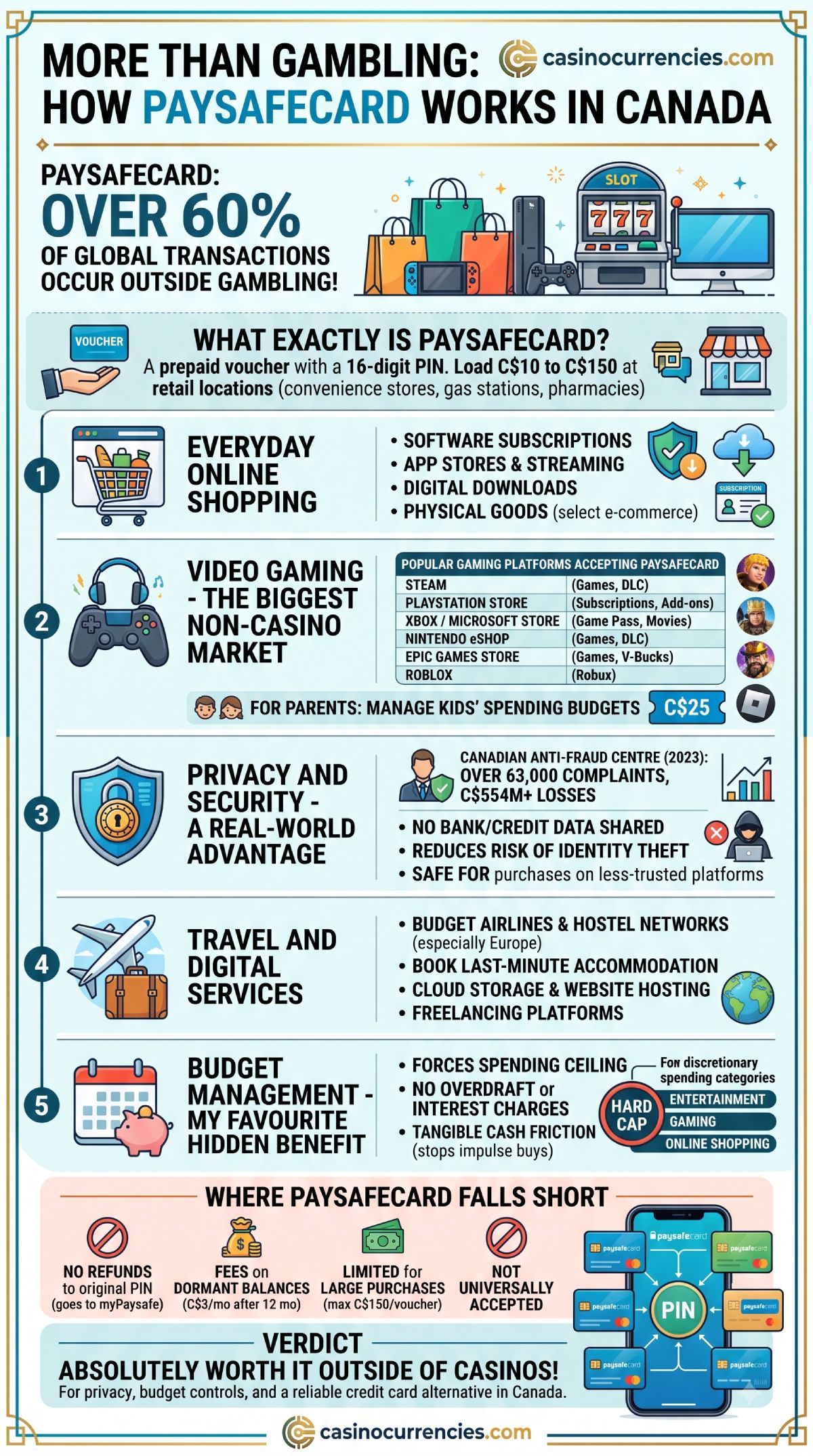
When most Canadian players hear "Paysafecard," their minds jump straight to online casino deposits. I get it - I've spent years reviewing Paysafecard casinos and writing about how this prepaid voucher dominates the iGaming payment space. But here's something that surprised even me when I first dug into the data: over 60% of global Paysafecard transactions actually happen outside of gambling. That number made me rethink everything I assumed about this payment method.
So let me walk you through what Paysafecard can actually do for you beyond spinning slots and placing bets. If you already use it at Paysafecard casinos in Canada, you're sitting on a tool with far more reach than you probably realize.
What Exactly Is Paysafecard?
For anyone who needs a quick refresher, Paysafecard is a prepaid payment voucher built around a simple 16-digit PIN code. You buy it at a retail location - convenience stores, gas stations, pharmacies - load it with anywhere from C$10 to C$150, and use that PIN to pay online. No bank account required. No credit card needed. No personal financial data shared with merchants.
Paysafe Group, the parent company behind the brand, processes over $150 billion in payment volume annually across its entire ecosystem. That kind of infrastructure doesn't get built on casino deposits alone.
Everyday Online Shopping
This is where Paysafecard quietly shines for everyday Canadians. Hundreds of online retailers across dozens of categories accept it as a payment method. I've personally used my Paysafecard PIN to purchase software subscriptions, digital downloads, and even physical goods from select e-commerce platforms.
Here are some of the most popular retail categories where Paysafecard works in Canada:
- Digital entertainment - streaming services, music platforms, app stores
- Gaming - Steam, PlayStation Store, Xbox, Nintendo eShop, and dozens of PC game marketplaces
- Software - antivirus programs, VPN subscriptions, productivity tools
- Telecommunications - prepaid mobile top-ups and VoIP services
- Social media and dating - premium memberships and in-app purchases
The convenience factor is massive. I keep a Paysafecard voucher in my wallet, just as some people carry a coffee gift card. When I want to grab a new game on Steam or renew a subscription without pulling out my Visa, the 16-digit PIN does the job in seconds.
Video Gaming - The Biggest Non-Casino Market
If you're a gamer in Canada, Paysafecard is practically a household name already. The global gaming industry generated over US$184 billion in revenue in 2023, and prepaid vouchers like Paysafecard have carved out a significant share of that payment volume.
Steam alone has over 120 million monthly active users, and Paysafecard is one of their most popular alternative payment options in markets like Canada, Germany, and the UK. I've spoken with younger players who don't even have a credit card yet - Paysafecard is literally their gateway into digital purchases.
Popular Gaming Platforms Accepting Paysafecard
| Platform | What You Can Buy | Typical Spend Range |
|---|---|---|
| Steam | Games, DLC, in-game items | C$5 – C$90 |
| PlayStation Store | Games, subscriptions, add-ons | C$10 – C$80 |
| Xbox / Microsoft Store | Games, Game Pass, movies | C$10 – C$70 |
| Nintendo eShop | Games, DLC | C$10 – C$60 |
| Epic Games Store | Games, V-Bucks | C$5 – C$100 |
| Roblox | Robux | C$5 – C$50 |
For parents managing their kids' gaming budgets, Paysafecard is a godsend. You hand them a C$25 voucher, and that's the spending ceiling. No worrying about runaway credit card charges or unauthorized purchases. I actually recommended this approach to a colleague last year, and she told me it completely eliminated the monthly arguments about her son's Fortnite spending.
Privacy and Security - A Real-World Advantage
Here's where my financial analyst background kicks in. In 2023, the Canadian Anti-Fraud Centre reported over 63,000 fraud complaints with losses exceeding C$554 million. Identity theft and online payment fraud made up a massive chunk of those numbers.
Paysafecard sidesteps most of these risks entirely. When you pay with a 16-digit PIN, the merchant never receives your name, bank account number, or credit card details. There's nothing to steal. Nothing to breach. For privacy-conscious Canadians - and I count myself among them - that's not a minor perk. It's a fundamental advantage.
I use Paysafecard specifically for purchases on platforms I don't fully trust. A new software vendor with limited reviews? A niche subscription service based overseas? I'd rather risk a C$25 prepaid voucher than hand over my Mastercard number. That calculation is simple risk management, and any financial professional would tell you the same thing.
Travel and Digital Services
This category is growing fast. Several travel booking platforms, particularly budget airlines and hostel networks in Europe, now accept Paysafecard. If you're a Canadian planning a backpacking trip or booking last-minute accommodation, the voucher payment option can be surprisingly handy - especially if you're already abroad and want to avoid international transaction fees on your credit card.
Digital services like cloud storage, website hosting, and even some freelancing platforms have also started integrating Paysafecard. The trend makes sense: any business targeting customers who value privacy or lack traditional banking access benefits from offering prepaid voucher payments.
Budget Management - My Favourite Hidden Benefit
I've worked in corporate finance. I've built spreadsheets that would make your eyes water. And I'll tell you this honestly: one of the smartest personal budgeting tools I've ever used is a simple prepaid voucher.
Paysafecard forces a spending ceiling. You load C$50, and that's all you can spend. There's no overdraft. No "I'll pay it off next month" temptation. No interest charges creeping up at 19.99% APR. For discretionary spending - entertainment, gaming, casual online shopping - that hard cap is incredibly effective.
I've recommended this strategy to readers who struggle with impulse purchases online. The psychology is straightforward: when you physically buy a voucher with cash, you feel the money leaving. That tangible friction slows down impulsive decisions in a way that tapping a saved credit card never will.
Where Paysafecard Falls Short
I wouldn't be doing my job if I only highlighted the positives. There are real limitations you should know about.
- No refunds to voucher. If a merchant issues a refund, it goes to your myPaysafe account, not back onto the original PIN. That's an extra step that can frustrate first-time users.
- Fees on dormant balances. If you don't use your Paysafecard for 12 months, a monthly maintenance fee of C$3 kicks in. That can quietly drain a forgotten voucher.
- Limited for large purchases. The maximum single voucher value of C$150 makes it impractical for big-ticket items, though you can combine up to 10 PINs in a single transaction.
- Not accepted everywhere. Despite growing adoption, Paysafecard still isn't as universally accepted as Visa or Mastercard. You won't be using it at Amazon Canada anytime soon.
The Verdict - Is Paysafecard Worth It Outside of Casinos?
Absolutely. After years of analyzing payment methods across the iGaming industry, I can confidently say Paysafecard's real-world utility extends far beyond casino deposits. For Canadian users who value privacy, need strict budget controls, or simply want a reliable alternative to credit cards for online purchases, the prepaid voucher model works remarkably well.
Is it going to replace your primary payment method? No. But it doesn't need to. Paysafecard occupies a smart, specific niche - secure, anonymous, budget-friendly online payments - and it fills that niche better than almost anything else available in Canada right now.
If you're already using Paysafecard at Canadian online casinos, start exploring what else it can do. You might be surprised how often that 16-digit PIN comes in handy outside the lobby.